
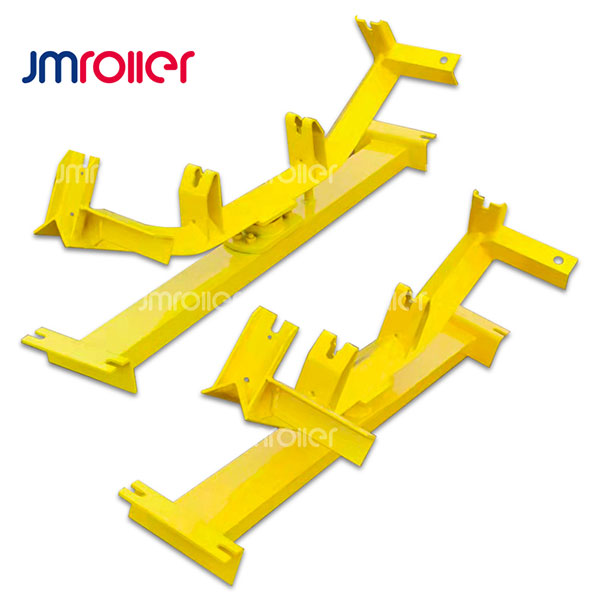
Product details
Self-aligning carrier frame is an important part of belt conveyor and is used to support rollers and roller sets
The whole roller sets of self-aligning carrier roller automatically trains belt and protects edges from damage cause misalignment.
The material is angle steel/channel steel/steel tube, and it is widely used in mining, metallurgical and coal industry. It can be produced by different sizes based on belt width, frame angle and conveyor types. It is a very important component of nonstandard machinery.
It’s produced with inclination degree of 30°,35°,45°
Application and selection guide
A self aligning carrier frame supports the carrying roller arrangement while allowing the designed aligning movement. Its pivot, stops and mounting geometry need to suit the conveyor structure and the operating space around the loaded belt.
Where this product fits
Describe the belt profile and how the aligning action is intended to work at the installation point. Include any current restrictions caused by guards, chutes or accumulated material.
Information for a suitable proposal
Show the pivot construction, movement envelope, roller seats and fixing centres. State whether the requested scope includes rollers and contact components or only the supporting frame.
A conveyor frame is a structural and dimensional interface between rollers and the main conveyor steelwork. Confirm the installation envelope, bolt positions, roller fixing details and required belt profile. Drawings are especially useful where the existing conveyor uses a site-specific bracket or an unusual mounting arrangement.
Installation and maintenance considerations
Inspect the pivot and stops for wear or obstruction. Confirm free intended movement and secure mounting after maintenance, without modifying the mechanism to mask another tracking problem.
State whether the frame will be supplied alone or together with rollers. Include the conveyed material and the intended location so that loading, access and contamination can be discussed. Before fitting, check the supporting steelwork for distortion and establish alignment with neighbouring stations; the replacement should sit squarely without forcing the mountings.
For related options, explore compatible roller set arrangements or discuss the application with JuMing.