
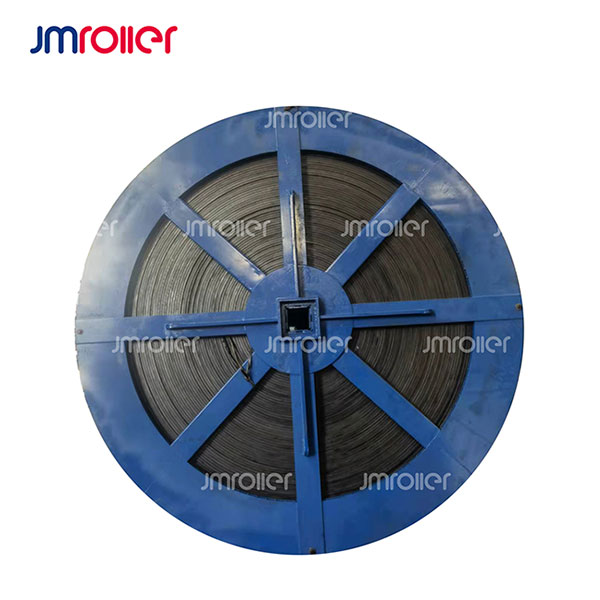
Product details
Usage:
Steel cord conveyor belt is extensively applied in coal, mining, port, metallurgy, power, chemical sectors for long-distance, large amount and high-speed conveying of materials.
Features:
1. High tensile strength: Steel cord conveyor belt is suitable for large span, long distance transportation of materials.
2. Small elongation in use: It need only a very short take-up stroke distance.
3. Small diameter of drive pulley: Steel cord conveyor belt body has a layer of longitudinally arranged steel cords as its carcass, and thus is resistant to flex fatigue. Therefore, drive pulley of smaller diameter can be used to make the equipment smaller.
4. High adhesion between rubber and steel cord: The steel cords are coated with zinc on their surface, and also the rubber used has the property of good adhesion with steel cords. Therefore, the rubber is tightly adhered to the steel cords and is resistant to shock and difficult to drop, so the rubber belts are long in life.
5. Even tension of steel cords: Out of our advanced techniques in manufacturing, the steel cords are very evenly arranged and have the same tension, so the belts are well balanced in running and difficult to run away.
6. Good troughability: As the belt body has no transverse skeleton, it is easy to from a deep trough, so the belts can load more materials and prevent the materials from escaping.
7. Inspection of the belt with X-rays: Users can X-rays to inspect damages of the skeleton steel cords on the conveyor machines to prevent accidents from happening.
Cover Compounds:
General, Fire-resistant, Cold-resistant, Abrasion-resistant, Heat-resistant and Chemical-resistant.
Standards offered:
GB/T9770, DIN22131, EN ISO 15236, BS490,JIS, SANS1366 and AS1333.
Application and selection guide
Steel cord conveyor belts use longitudinal steel reinforcement within a covered belt construction. Their selection and replacement should be reviewed against the complete conveyor design, with particular attention to the existing belt designation, pulley arrangement and planned splice.
Where this product fits
Discuss the route, conveying duty and current belt condition with the responsible project team. A replacement plan should cover installation handling and the interfaces with take-up and drive equipment.
Information for a suitable proposal
Provide the existing belt marking, construction drawing, dimensions and splice specification. Describe the operating environment and any local damage or wear that has influenced the enquiry.
A conveyor belt should be specified around the complete conveying duty. Describe the material, loading method, incline, belt speed and environmental exposure, then provide the existing belt designation or conveyor drawing. The carcass, covers, pulley arrangement and proposed splice need to be considered together.
Installation and maintenance considerations
Inspect edges, covers and the splice using the site’s approved methods. Installation and repair work should follow the belt supplier’s instructions and the agreed procedures for the specific construction.
For a replacement, note the current wear pattern and whether the difficulty is abrasion, impact, carryback or tracking. These observations are useful when reviewing options. Storage, handling and installation should protect the belt from deformation and contamination, and the splice and commissioning procedure should be agreed with the responsible installation team before the belt is put into service.
For related options, explore other conveyor belt constructions or discuss the application with JuMing.