
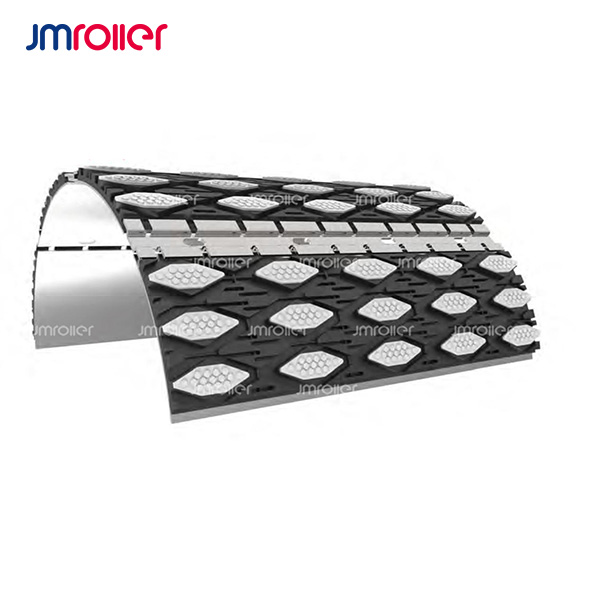
Product details
It is suitable forpulley lagging of long-distance and high-speed belt
conveying equipment. It has good anti-slip ability, and prolongs equipment
startup time by reducing the replacement frequency and replacement time of
lagging.
Product Features:
1、Installation is more convenient and faster, and the replacement saves 50%
of labor;
2 、It will not hurt the non-working surface of the conveyor belt, which is
more friendly to the conveyor belt;
3 、Provide >30000 hours service life under normal working conditions;
4、Suitable for conveyor belt slippage, muddy, belt speed ≥3m/s, conveying
capacity 1500t/h;
5、Safer hot vulcanization bonding process.
Product Parameters:
| Ceramic Tiles | |
| Al₂O₃ Content | 92%,95% |
| Volume Density | 3.65~4.5g/cm³ |
| Tensile Strength | 20 Mpa |
| Compressive Strength | 200 Mpa |
| Hardness(Mohs) | >9t |
| Water Absorption | <0.02 |
| Abrasion | <120 mm4 |
| Rubber | |
| Polymer | NR/SBR |
| Specific Gravity | 1.2+/-0.03 |
| Shore a (hardness) | 65+/-5 |
| Elongation at break | 400% |
| Tensile strength | 17 N/mm² |
| Abrasion Loss | <120 mm3 |
| Commodity | Thickness.mm | Width. mm | Length. mm |
| Normal Ceramic Lagging | 12/15/18/20 | 500 | Customized |
| Flame Retardant Ceramic Lagging | 12/15/18/20 | 500 | Customized |
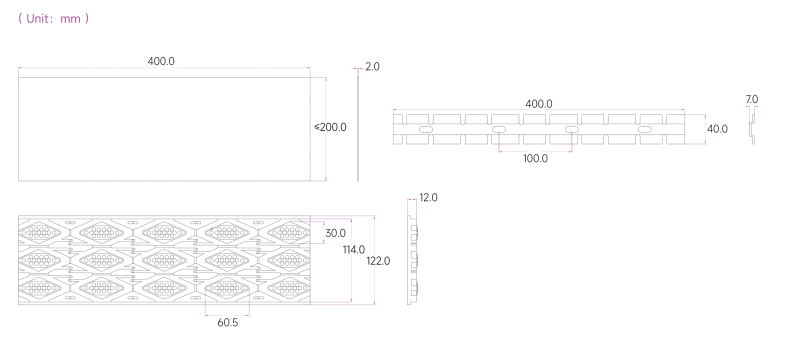
Product Size:
Application and selection guide
HGSRL-G is presented as a general purpose ceramic slide-lag option for compatible pulley arrangements. It combines a ceramic wearing surface with a replaceable mounting concept that must be checked against the pulley’s actual retention and rail details.
Where this product fits
Consider this variant where a mechanically retained ceramic surface is being reviewed. Explain the current replacement method and the access available for removing and securing lagging sections.
Information for a suitable proposal
Provide pulley dimensions, rail or fixing drawings and the existing segment layout. Compare the general purpose and heavy duty ceramic slide-lag variants using the same belt and operating information.
A slide-lag arrangement introduces a mechanical interface between the replaceable lagging and the pulley shell. Record the existing rail or retention details, segment layout and available access. A replacement strip must be compatible with the mounting system as well as suitable for the operating duty.
Installation and maintenance considerations
Inspect rails, retainers and end fixing areas along with the ceramic surface. Replace damaged attachment components before fitting new wearing sections.
Provide photographs of the end retention and the areas showing wear. Discuss how worn components are removed and secured during replacement, and agree inspection access with the maintenance team. Damage to a rail or fixing should be assessed before new lagging is installed; a sound wearing surface cannot make up for an insecure attachment.
For related options, explore bonded and mechanically retained lagging or discuss the application with JuMing.