
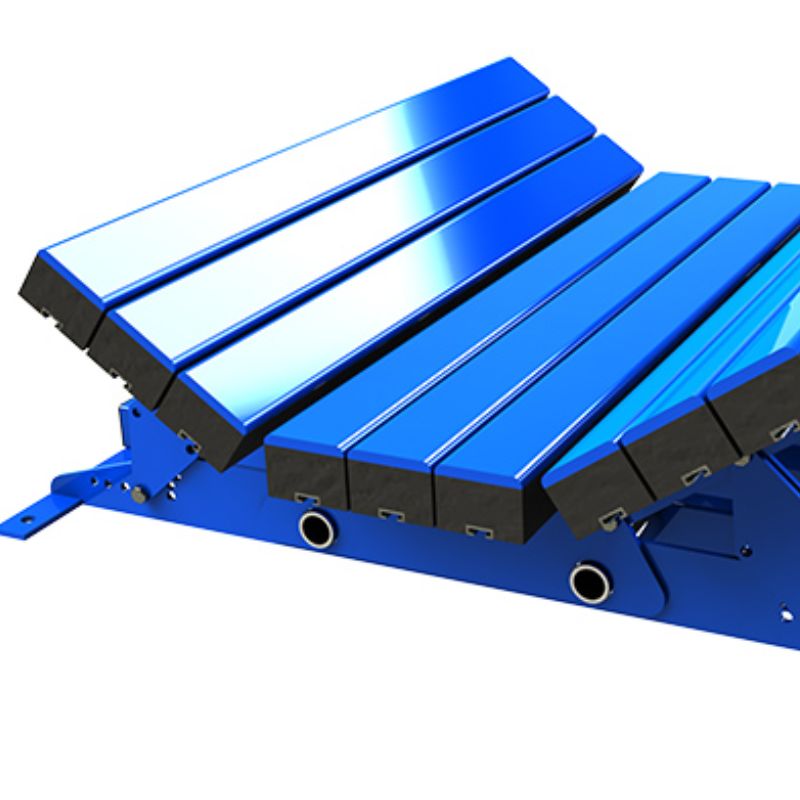
Product details
Main functions of impact bed
1. Shock mitigation: When large or heavy materials fall on the conveyor belt, the impact bed protects the conveyor belt and materials by absorbing and dispersing the impact force.
2. Preventing conveyor belt tearing: Reducing the direct impact of materials on the conveyor belt prevents the conveyor belt from tearing or premature wear.
3. Reducing material spillage: Stabilizing the conveyor belt at the receiving point helps prevent material spillage, thereby keeping the conveyor belt system clean and running efficiently.
4. Improving conveyor belt life: Extending the service life of the conveyor belt by reducing wear and damage.
Components of impact bed
1. Support frame: Usually made of steel, providing strong structural support.
2. Buffer strip: Made of highly elastic and wear-resistant materials such as polyurethane or rubber, responsible for absorbing and dispersing impact forces.
3. Fixture: Used to firmly mount the impact bed on the frame of the conveyor belt system.
Application scenarios of impact beds
Mines: When handling and transporting heavy materials such as ore and coal.
Metallurgy: The transportation process of handling heavy materials such as steel.
Power plants: Conveyor systems for coal and other fuels.
Ports: Conveyor belt systems when loading and unloading goods
Building materials and chemicals: Occasions where large amounts of bulk materials need to be handled and transported.
Application and selection guide
An impact bed provides support beneath the belt at a defined loading zone using an assembled support and wearing-element arrangement. Selection should consider the chute, material landing position, belt profile and access for maintaining the complete transfer point.
Where this product fits
Explain where material lands and whether the current problem is belt damage, poor sealing or spillage. A layout of the full loading area is more useful than an isolated bed dimension.
Information for a suitable proposal
Provide belt and chute drawings, material characteristics, available installation space and the current support arrangement. Include requirements for replacing individual wearing elements during planned shutdowns.
Loading-zone support should be evaluated together with the chute, belt, skirting and conveyor structure. Provide a layout showing the material trajectory, belt profile, loading height and available access. Particle size and the way material lands on the belt are as relevant as the nominal conveying rate.
Installation and maintenance considerations
Inspect support elements, fixings and clearances around the loading zone. Review the bed together with skirting and chute alignment when persistent wear or leakage appears.
For a replacement, include photographs of belt damage, worn support elements or persistent spillage. Explain how the assembly is accessed during a shutdown and whether individual wearing parts need to be replaceable. Check support alignment and clearances before commissioning; the correct arrangement depends on the complete transfer point rather than one component considered in isolation.
For related options, explore impact beds and replaceable impact bars or discuss the application with JuMing.