
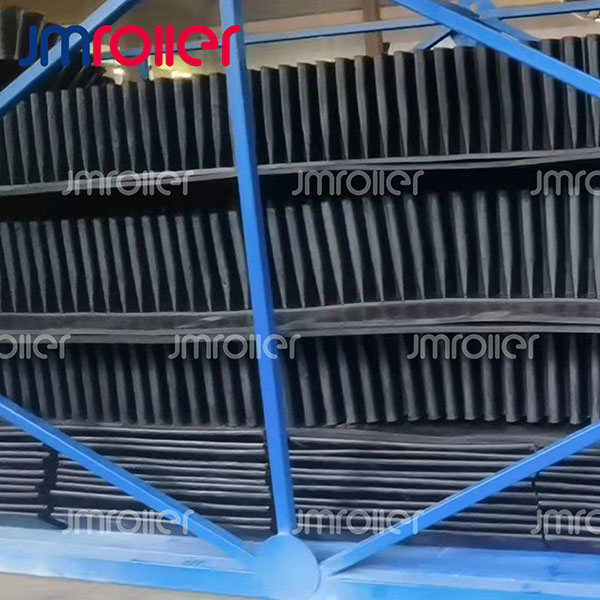
Product details
Usage:
In order to prevent the conveying materials scattering due to site restrictions or the requirement for lifting materials with large dip angel, the sidewall conveyor belt must be able to withstand the extremely high stress and repeated flexing that occurs in high capacity, steep angle conveying. It is specially designed by JM Belt engineers by using the polyester fabrics with the highest quality and extremely low elongation to provide higher rigidity value. This product is suitable for conveying materials under the condition of large dip angle (0°-90°).
Characteristics:
Materials can be conveyed at a large slope up to 90°.
The belt has large loading capacity and the materials won’t be scattered.
The slope of conveying can be changed from horizontal to sloping, or from sloping to horizontal.
The conveyor is simple in structure, flexible in arrangement and occupying only a small area.
Application and selection guide
A corrugated sidewall conveyor belt carries material within a raised-edge arrangement suited to a defined conveying layout. Its sidewalls, cleats and base belt must be considered together with pulleys, supports and the available loading and discharge space.
Where this product fits
Describe the conveyor route and how material enters and leaves the belt. Show changes in direction or incline where the belt profile must remain compatible with the surrounding structure.
Information for a suitable proposal
Provide the existing belt drawing or proposed layout, material characteristics and the required sidewall and cleat arrangement. Include pulley and support information for a review of the complete belt path.
A conveyor belt should be specified around the complete conveying duty. Describe the material, loading method, incline, belt speed and environmental exposure, then provide the existing belt designation or conveyor drawing. The carcass, covers, pulley arrangement and proposed splice need to be considered together.
Installation and maintenance considerations
Inspect sidewall and cleat connections as well as the base belt. Keep loading centred and investigate local rubbing or trapped material before these damage the profile.
For a replacement, note the current wear pattern and whether the difficulty is abrasion, impact, carryback or tracking. These observations are useful when reviewing options. Storage, handling and installation should protect the belt from deformation and contamination, and the splice and commissioning procedure should be agreed with the responsible installation team before the belt is put into service.
For related options, explore other conveyor belt constructions or discuss the application with JuMing.