
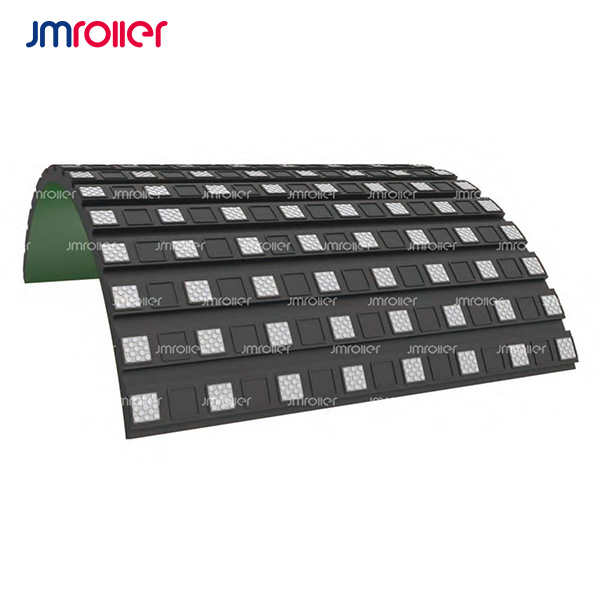
Product details
An economical solution to effectively extend the life of pulley lagging.
Product Features:
1、Combined with DCCDo cleaning agent, metal treatment agent and cement, it
can produce the maximum bonding strength and is safer to use;
2、It will not hurt the non-working surface of the conveyor belt, which is
more friendly to the conveyor belt;
3、Provide >20000 hours service life under normal working conditions;
4、Economical solution for increased slip resistance and service life;
5、Unique ceramic tiles bonding technology, ceramic tile is not easy to fall
off;
6、No need to grind the CN layer.
Product Parameters:
| Rubber | |
| Polymer | NR/SBR |
| Specific Gravity | 1.2 +/-0.03 |
| Shore a (hardness) | 65+/-5 |
| Elongation at break | 400 % |
| Tensile strength. | 17 N/mm² |
| Abrasion Loss | <120 mm3 |
| Ceramic Tiles | |
| Al₂O₃ Content | 92%,95% |
| Volume Density | 3.65~4.5g/cm³ |
| Tensile Strength | 20 Mpa |
| Compressive Strength | 200 Mpa |
| Hardness (Mohs) | >9t |
| Water Absorption | <0.02 |
| Abrasion | <120 mm4 |
| Commodity | Thickness.mm | Width. mm | Length.mm |
| Normal Ceramic Lagging | 12/15/18/20 | 500 | Customized |
| Flame Retardant Ceramic Lagging | 12/15/18/20 | 500 | Customized |
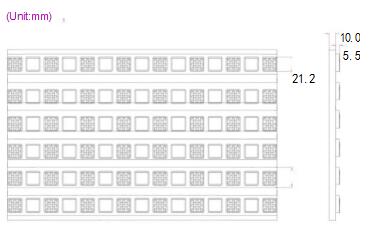
Product Size:
Application and selection guide
HCRL-19% is presented in the archived range as a light duty ceramic cold bonding rubber lagging option. Review the labelled ceramic coverage and bonded installation arrangement against the actual pulley duty, belt contact and existing surface condition.
Where this product fits
This variant offers a starting point for comparing the ceramic coverage options in the range. Explain why lagging is being changed and describe moisture, fines or observed belt slip.
Information for a suitable proposal
Provide pulley face dimensions, existing covering details and the intended bonding arrangement. Compare this option with the medium and heavy duty variants using the same operating information.
Ceramic lagging selection should consider drive duty, belt condition, moisture and the existing pulley surface. The product family includes different coverage and installation arrangements. Compare them against the operating problem rather than assuming that a higher ceramic proportion is automatically preferable for every conveyor.
Installation and maintenance considerations
Inspect for lifting edges, worn ceramic areas and material trapped at joints. Bonding preparation should follow the chosen installation system rather than an improvised repair method.
Provide pulley face dimensions, the existing covering and photographs of wear or slip marks. The bonding or mounting procedure, surface preparation and return-to-service conditions should be agreed with the installation team. Inspect the surrounding belt and cleaner arrangement as well; lagging is one part of the drive system and does not resolve every cause of belt slip.
For related options, explore the full pulley lagging range or discuss the application with JuMing.