
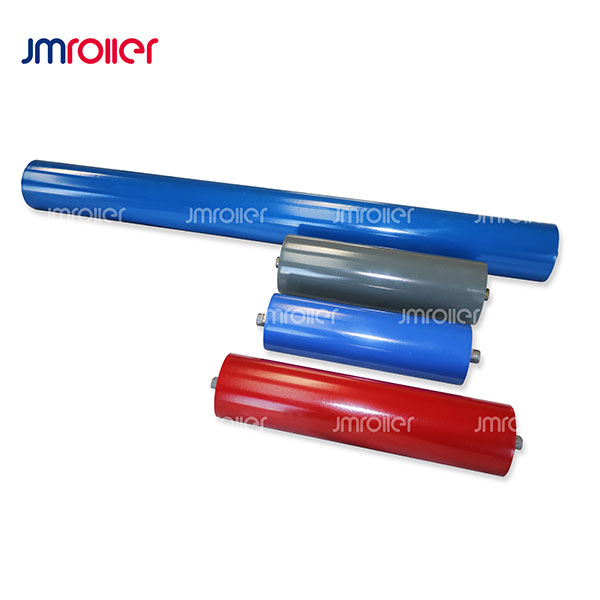
Product details
Conveyor Return Roller are installed on the side under the conveyor to
provide support to the returning conveyor belt. these conveyor return rollers
are designed to enable use as carry idler and support the conveyor belt from
below in a flat belt situation.
We designed conveyor return rollers fit any belt 24″ to 72″ wide to reduce
the risk of injury.
Conveyor return rollers are designed to allow for service from one side of
the conveyor.
Three-piece hanger frame adjusts to accommodate different belt widths.
Bracket fits are designed as per universal specification fit most major idler
manufacturers’ idlers and sizes.
Application:
Mining
Steel mill
Cement plant
Power plant
Chemical Plant
Sea Port
Storage
etc.
Application and selection guide
Return rollers support the unloaded belt on its path back to the loading point. Their selection should account for the return belt profile, material carried back from discharge and the mounting arrangement along the lower conveyor structure.
Where this product fits
Assess whether a plain return roller is appropriate or whether the application calls for discs, a spiral arrangement or a shaped return set. The condition of the returning belt helps explain the requirement.
Information for a suitable proposal
Provide belt width, roller dimensions, shaft ends and details of carryback or moisture. Include the return support spacing and any current rubbing or uneven wear observations.
The roller, its mounting frame and the belt form one working assembly. Confirm the shell length, shaft end form and installed clearances against the existing structure. Photographs help identify the arrangement, while an approved drawing is preferable when the replacement must fit an established conveyor.
Installation and maintenance considerations
Inspect for seized rollers, deposited material and clearance to the structure. Carryback should be addressed as a system issue involving cleaning as well as return support.
Include belt speed, conveyed material, expected contamination and the position on the conveyor in the inquiry. A carrying position, a loading point and a return strand expose a roller to different duties. Ask for the proposed bearing and sealing arrangement to be checked against those conditions rather than choosing by outside appearance alone.
For related options, explore roller sets and supporting arrangements or discuss the application with JuMing.